

President Yoweri Kaguta Museveni has challenged farmers in Sheema District to abandon subsistence farming and embrace commercial agriculture, irrigation, fertiliser application and improved livestock management as part of efforts to combat poverty and protect household incomes against prolonged drought.
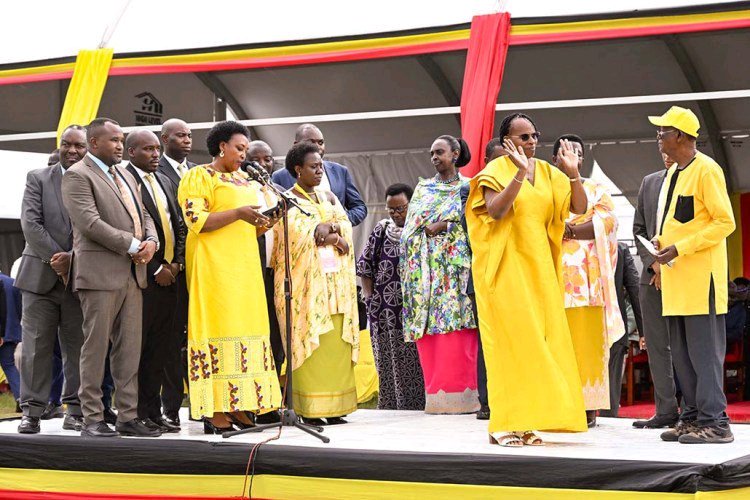
Museveni made the call on Saturday while officiating at a thanksgiving ceremony for Prof. Ephraim Kamuntu, the Minister of Internal Affairs and Sheema County South Member of Parliament, held at Bugongi Town Council Playground. The President thanked residents for supporting him and Kamuntu during the recent elections, urging local leaders to intensify efforts to improve household incomes through wealth creation.
The President traced his commitment to fighting poverty to his school days at Mbarara High School and Ntare School, where he developed an interest in agricultural production and its potential to transform communities. He recalled visiting government farms to learn about livestock management, milk production and modern farming practices, saying these experiences shaped his determination to help Ugandans move away from subsistence livelihoods.
Museveni explained that the four-acre model, introduced in the 1996 National Resistance Movement manifesto, was designed to help families with limited land generate income through commercial farming. He encouraged households to allocate land to coffee, fruit growing, pasture and food crops, while supplementing earnings through poultry, piggery and fish farming where conditions permit. He urged leaders to reach households that have not yet embraced income-generating activities.
Addressing the drought affecting banana plantations in Sheema and other parts of the country, Museveni identified irrigation as a critical solution to sustaining agricultural production during periods of inadequate rainfall. He said underground water resources in parts of Ankole and Kigezi could be tapped to support farmers, while also urging them to grow pasture, apply fertilisers and adopt better livestock management practices instead of relying on uncontrolled free-range grazing.
The President also called on families to protect their wealth across generations by avoiding unnecessary subdivision of productive property after the death of parents. He suggested that families could establish companies to own property and distribute shares among beneficiaries, allowing them to inherit interests without fragmenting land and other assets into smaller, less productive units. On infrastructure, Museveni pledged government support for roads, the construction of Kitagata Hospital and other development initiatives, while committing two tractors to Sheema District to help address agricultural challenges.
Deputy Speaker of Parliament Thomas Tayebwa commended Museveni for dedicating five square miles of land in Ruhengyere, Kiruhura District, to the Ankole sub-region for industrial development and job creation. However, he appealed for further government intervention to rescue Igara Tea Factory, warning that its financial difficulties could result in the facility being taken over by a bank. Tayebwa noted that the President had already directed the Uganda Revenue Authority to waive the factory’s tax arrears.
In his remarks, Kamuntu thanked Museveni for attending the thanksgiving ceremony, recalling their longstanding relationship dating back to their school years.
He defended the value of experience in leadership, arguing that a leader’s contribution should matter more than age, and praised government programmes such as the Parish Development Model and Emyooga for their contribution to livelihoods in Sheema. Kamuntu pledged continued cooperation with the government to advance development programmes and improve living standards, as religious leaders, government officials, legislators and local leaders joined residents for the ceremony.