
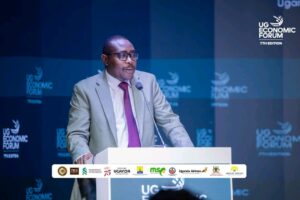



Odrek Rwabwogo, the chairman of the Presidential Advisory Committee on Exports and Industrial Development (PACEID), has responded strongly to allegations made by Kasambya County Member of Parliament Daudi Kabanda over claims involving land ownership and his business projects in Kiruhura District.
Rwabwogo said he was deeply hurt by the accusations, arguing that some people had judged him without understanding his background, values and the work he has done in promoting Uganda’s agricultural and industrial development.
“I am deeply hurt because some of you do not know much about me; when you hear these ridiculous claims you may be tempted to believe them,” Rwabwogo said while responding to the allegations.
Kabanda had accused Rwabwogo of benefiting from government land in Kiruhura District under the National Animal Genetic Resources Centre and Data Bank (NAGRC&DB), claiming the land was acquired after promises of establishing a major milk factory and livestock project.
The legislator further alleged that the promised projects had not benefited local communities as expected and questioned whether some of the land was being used for private commercial interests.
Rwabwogo rejected the allegations, saying the Nshaara Industrial Park was established to promote agro-industrialisation and create opportunities for farmers rather than to benefit him personally.

He explained that through his investments, he had focused on meat processing, coffee production and supporting farmers to participate in value addition and export markets.
Rwabwogo said plans for a major abattoir faced several challenges, including the Covid-19 pandemic, difficulties in securing enough cattle supplies and delays in obtaining export certification for international markets.
According to him, the project required a reliable supply of about 150 cattle every day, but getting enough animals of the required standards became a major challenge.
He added that his team had also faced difficulties accessing certification needed to export products to China, which slowed down some of the planned investments.
The PACEID chairman said he continues pushing for reforms that would improve Uganda’s food certification systems and help local producers access more international markets.
He also defended the performance of his milk factory in Rushere, saying it had purchased milk worth more than Shs11 billion from farmers over a period of nine years.
Rwabwogo denied claims that farmers had gone unpaid, explaining that a previous arrangement involving an intermediary who collected milk failed after the person allegedly mismanaged Shs800 million that had been provided for the activity.
He said the company later changed its approach and began purchasing milk directly from farmers to ensure that producers receive their payments without delays.
Rwabwogo also accused his critics of focusing on spreading accusations instead of recognising investments that create jobs and support local communities.

He questioned what some of his critics had done to improve the lives of ordinary Ugandans, arguing that building factories and creating markets for farmers was more important than making political attacks.
The businessman also highlighted some community projects he said he had supported, including improving access to water, supporting schools and helping with church renovations.
He further defended his relationship with the ruling National Resistance Movement (NRM), saying some attacks against him were aimed at weakening the party’s ideology and distracting leaders from development work.
Rwabwogo also addressed criticism over his decision to visit opposition leaders in prison, saying compassion and respect for the law should not be viewed as political betrayal.
He insisted that Uganda needs reconciliation, dialogue and peaceful engagement among people with different political views, adding that he would continue supporting efforts that bring citizens together.
He concluded by saying he would not be intimidated by accusations and urged Ugandans to focus on truth, development and unity instead of allowing political disagreements to divide the country.




